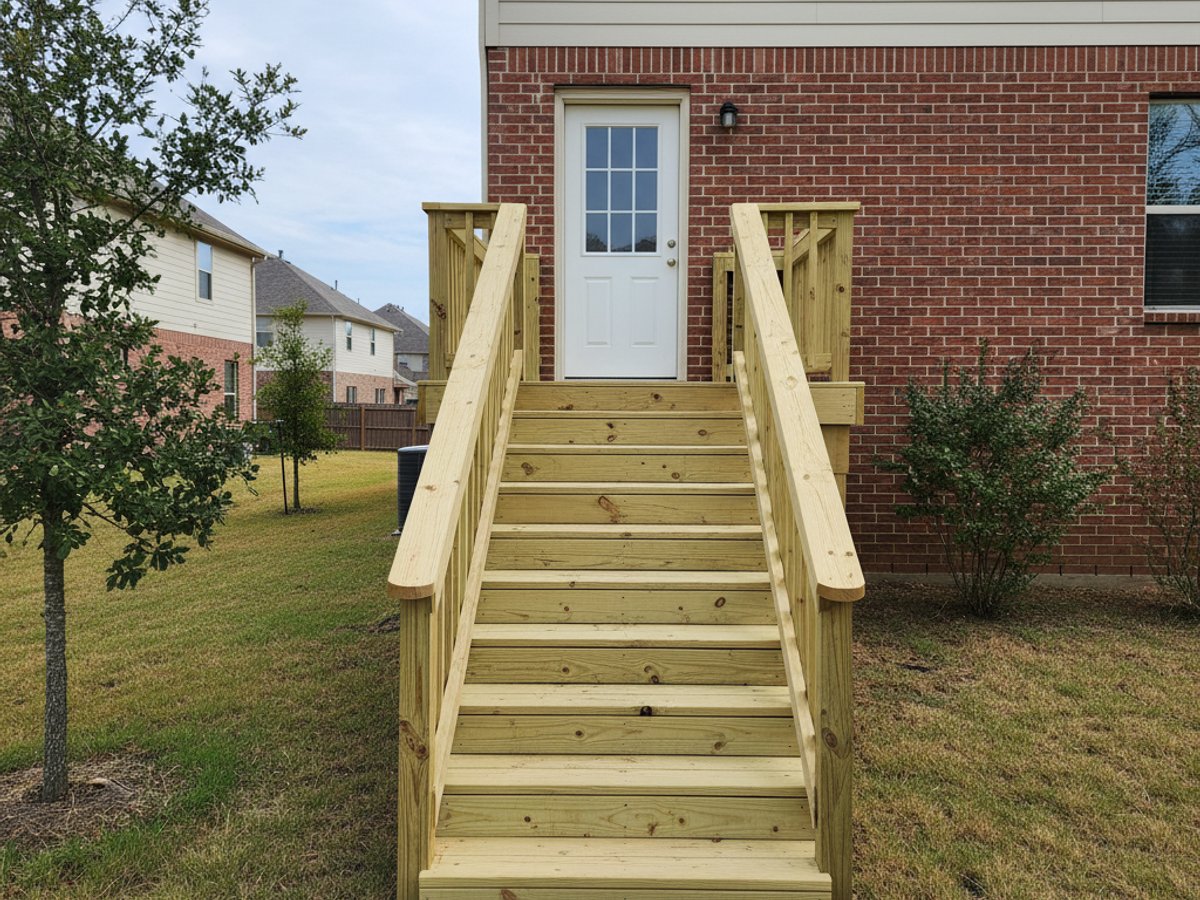
Most homeowners start a deck project by picking board colors and railing styles. That's backwards. The things that actually decide whether a deck lasts 20 years or starts sagging in five are mostly invisible once it's built, and most of them have to be checked before anyone digs a hole. Here's what we look at on every job in Allen, and what you should be asking about too.
1. Call 811 before anything else
This one's free and it's the law. Allen has irrigation lines, gas lines, and sometimes low-voltage lighting wire running closer to the surface than people expect, especially on lots with sprinkler systems installed after the original build. Locates usually come back within a few business days. Dig before they mark the yard and you're the one paying to fix a cut line.
2. Know what's actually under the yard
Most of Allen sits on Blackland Prairie clay, heavy stuff that swells when it's wet and shrinks hard when it dries out in August. That movement is the main reason deck footings in this area need to go deeper than you'd guess, usually 24 to 36 inches, with a bell shape at the bottom or a helical pier if the clay is bad enough. A footing that's too shallow will heave over a few wet-dry cycles and take a post out of level with it. This isn't optional engineering, it's the difference between a deck that stays flat and one that starts rocking after year two.
If you're near older parts of town close to Bethany Lake Park or downtown, lots were often filled or regraded decades ago and the clay profile can be inconsistent across one yard. Newer subdivisions like Twin Creeks or Montgomery Farm tend to have more uniform fill, but that's not a guarantee.
3. Pull a survey and check your setback
The City of Allen requires a permit for most attached decks, and the application wants to see where the structure sits relative to your property lines. Rear setbacks typically run 10 to 15 feet depending on zoning, and corner lots have an extra side setback to worry about. Fence lines lie. We've measured plenty of Allen yards where the actual property line is two or three feet off from where the fence sits, especially in older sections platted before GPS surveying was standard. If you don't have a current survey, get one before you design around a line that might be wrong.
4. Check your HOA, not just the city
Most subdivisions built in Allen since the 1990s have an HOA with an architectural review process, and a city permit does not replace that approval. Boards usually want material samples, a color that matches the house trim, and sometimes a height cap. Submit late and you can end up with a finished deck and a letter demanding changes. Older, unincorporated-feeling streets near the original town center are less likely to have an HOA at all, so this step depends heavily on which part of Allen you're in.
5. Know what the inspector will actually look at
A City of Allen inspector checking a deck permit is looking at footing depth and diameter, the post-to-beam connections, joist hanger hardware, and beam sizing against the span. The single most common failure point on older decks, and the thing inspectors scrutinize hardest on new ones, is the ledger board where the deck attaches to the house. It needs proper flashing and lag bolts or through-bolts, not just nails toe-driven into the rim joist. Water getting behind an unflashed ledger is how houses end up with rotted rim joists hiding under a perfectly fine-looking deck.
6. Think about where the water goes
Clay doesn't drain, it sheds. On a typical Allen lot the grade needs to carry water away from the house and toward the street or a drainage easement, and a deck built flat against the ground interrupts that path if nobody thinks about it. Standing water pooling under a low deck will keep the clay around the footings wet long after a storm has passed, which is exactly the swelling cycle that causes movement. During the heavier spring storms in March through May, a few inches of rain in an afternoon is normal here, so the ground under and around the deck needs somewhere to send it.
7. Match the material to Allen summers, not just your budget
July and August regularly sit above 100 degrees here, and that heat matters for board choice. Composite decking expands and contracts more than people expect across that range, so gapping between boards has to follow the manufacturer's spec exactly, not a rule of thumb. Pressure-treated pine is cheaper up front but will cup or check if it isn't sealed within the first year, and the dry heat accelerates that faster than it would in a milder climate.
8. If you're resurfacing or repairing, check what's underneath first
- Ledger flashing for rust streaks or soft wood around the bolts.
- Joists for soft spots, probe with a screwdriver near the ledger and at post bases.
- Post bases for rust or concrete that's cracked and let the post shift.
New boards on a bad frame just hide the problem for another season.
9. Ask how railing height and spacing get inspected
Most residential code requires a guard rail at 36 inches for decks over 30 inches off grade, with baluster spacing no more than 4 inches apart. This trips people up on elevated and multi-level decks more than anything else, because the taller the deck, the more exposed that railing detail is to an inspector's tape measure.
10. Don't assume last year's permit still applies
If you pulled a permit, paused the project, and picked it back up a year or two later, check whether it's still valid. Permits expire, and if the city updated its code in the meantime, your plans might need a revision before work starts again.
None of this is complicated once you know to look for it, but it's easy to skip when you're focused on picking out a stain color. We walk through all ten of these on every estimate, before a single post hole gets dug. If you want someone to check your yard against this list in person, that's the kind of work Oasis Deck Company does every week around Allen.